
Diagnosed with ADHD but still feeling lost? You’re not alone. Here’s how digital stories helped me connect, reflect, and actually start healing.
Before I Had a Diagnosis, I Had a Story
Before I understood what was “wrong” with me, I saw it written in someone else’s story.
It wasn’t a medical journal. It wasn’t a textbook.
It was a messy TikTok, stitched together with humor and heartbreak — and it felt more accurate than any diagnosis I’d ever read.
The Limit of Labels
Getting diagnosed with ADHD was… clarifying. It gave me structure. A framework. A reason.
But it didn’t comfort me. It didn’t explain why I felt broken, misunderstood, or chronically “too much.” Because a label can’t hold space for nuance, culture, or unspoken emotion.
A label is a name — not a narrative.
“A diagnosis gave me a word. But it was other people’s stories that gave me meaning.”
📱 When the Algorithm Became the Author of My Story
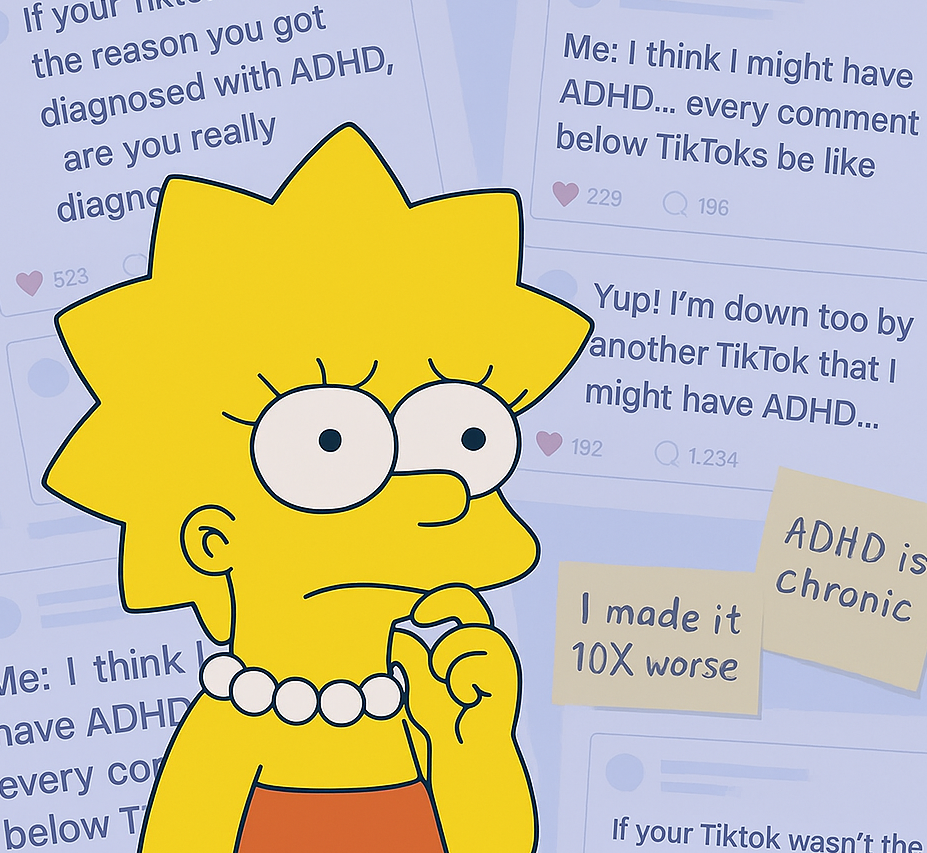
What fiction once did for me, TikTok now does — only faster, messier, and more painfully accurate.
Each 30-second clip became a scene in my personal documentary, stitched together by an algorithm that somehow knew my inner monologue before I did.
ADHD paralysis: how it looks vs. how it feels
It started with this video by @olivialutfallah. It wasn’t a how-to guide or a clinical checklist — it was a feeling.
Watching her try to start something — anything — while her brain froze mid-task hit like a mirror I didn’t know I needed.
Suddenly, “lazy” didn’t fit anymore. “Overwhelmed” did.
What my brain sounds like
Then came @connorcallec — a chaotic symphony of overlapping thoughts and sensory noise.
It wasn’t content; it was immersion.
I didn’t just watch it — I felt it.
This was narrative transportation in real time: my attention, my emotion, my empathy pulled into someone else’s experience that mirrored my own.
The one that broke me
And then, the one that broke me — @han_fitzy talking about late diagnosis.
The quiet grief. The relief tangled with regret.
It was only 45 seconds long, but I sat there thinking: this is what it looks like when someone puts language to a lifetime of confusion.
Dr. Katalin Bálint calls this being moved by narrative — when a story’s emotional truth shifts our perspective, whether it’s fiction or a TikTok filmed in soft lighting at 2 a.m.
Each clip became more than a distraction — it was a mirror.
In 30-second bursts, these creators did what stories have always done: they held up a reflection and let me see myself with a little more compassion.
Where the Healing Actually Started
I found creators on TikTok who didn’t just “talk about ADHD” — they embodied it.
Through jokes. Rants. Meltdowns. Joy.
In their stories, I saw mine. I laughed, cried, hit replay.
These weren’t just distractions. They were mirrors.
And somehow, they made me feel… human again.
Research backs this up. According to Bálint & Bilandzic (2017), narrative storytelling can evoke emotional engagement and empathy in ways that facts can’t.
Stories help us connect, shift attitudes, and process complex realities — especially around health and identity.
The Power of Being Moved by a Story
As I explored this more, I realized: I didn’t feel better because I got diagnosed.
I felt better because someone told a story that held my experience — without shame.
And in that moment, I felt seen.
This aligns with Dr. Katalin Bálint’s research on narrative persuasion and transportation — the idea that when we’re emotionally immersed in a story, it doesn’t just entertain us… it transforms us.
“It wasn’t the label that changed me. It was the story that said: ‘You’re not alone.’”
From Personal Healing to Research Inspiration
As I develop my PhD project on narrative vulnerability in digital Arab media spaces, I keep returning to this truth:
The stories that heal us don’t need to be fiction. They just need to be real.
Whether it’s a TikTok confessional or a voice note meme, these are the new emotional texts of our time.
They shape how we relate to our identities, to each other, and to mental health itself.
And I believe — like Dr. Bálint’s work affirms — that how a story is told matters as much as what’s told.
💬 Closing Reflection
I was never healed by a diagnosis.
But I was seen by a story.
And maybe that’s what real healing begins with — not labels, but language.
Not categories, but connection.
✨ Want to learn how humor became more than a coping mechanism?
This post breaks down how ADHD memes turned into a language of care, connection, and community.
👉 Read: Between LOL and SOS
📣 Share this blog with someone whose story helped you feel seen.
📚 References
- Bálint, K., & Bilandzic, H. (2017). Health Communication Through Media Narratives. International Journal of Communication, 11, 3734–3754.
- Bálint, K. et al. (2020). The Effect of Close-Up Frequency on Mental State Attribution. Poetics, 80, 101438.
